The Signature Is Part of the Picture
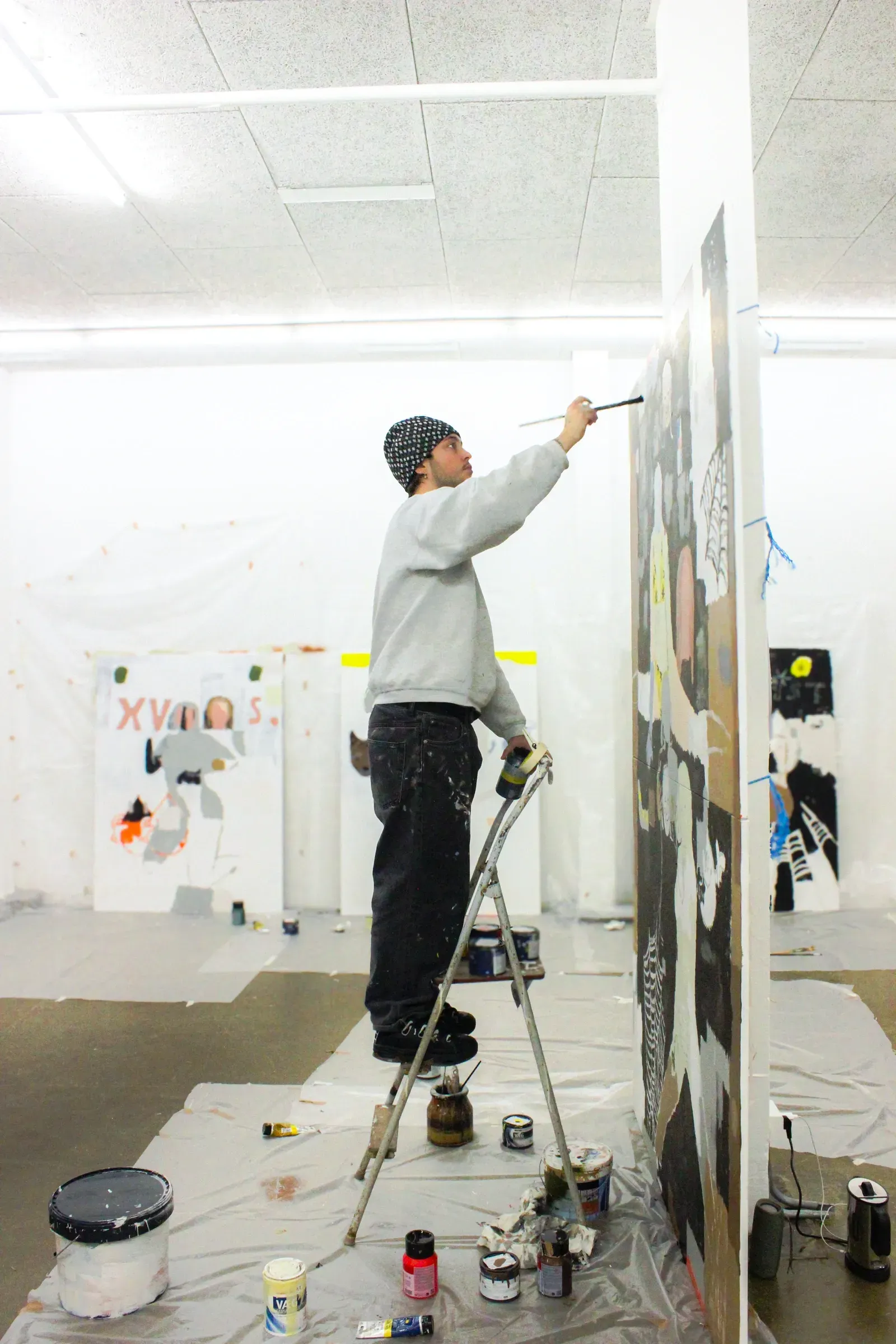
Abel Kabel: Aarhus, Denmark, Painting and Sculpture
Posters, record sleeves, hand-painted signs: the pictures borrow from things made to be read at a glance. Titles are lettered straight into the paint, in a cursive that could belong on a menu or in blunt capitals. The artist's name sits near the edge of almost every sheet and canvas, as if each picture had come with its own label.
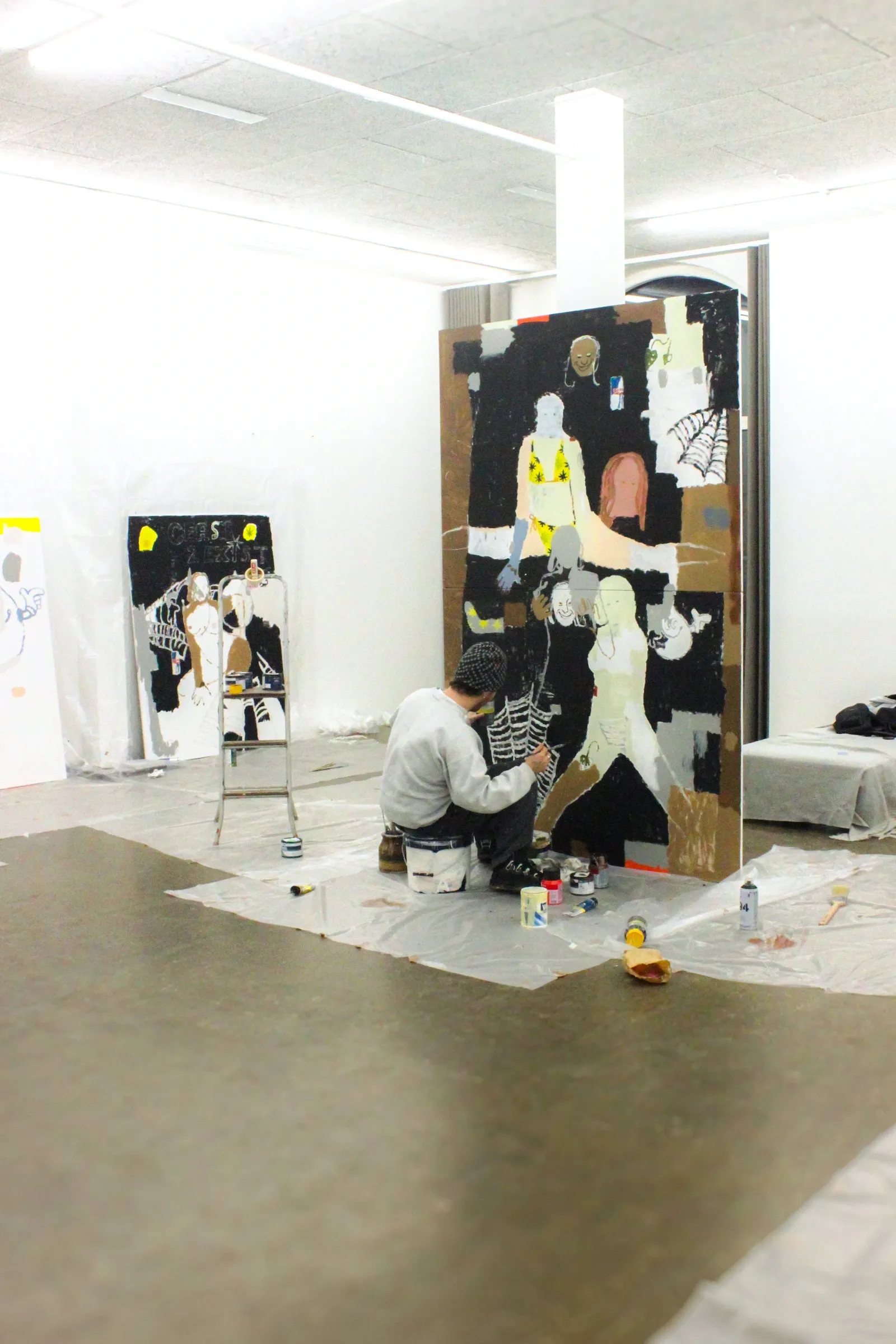
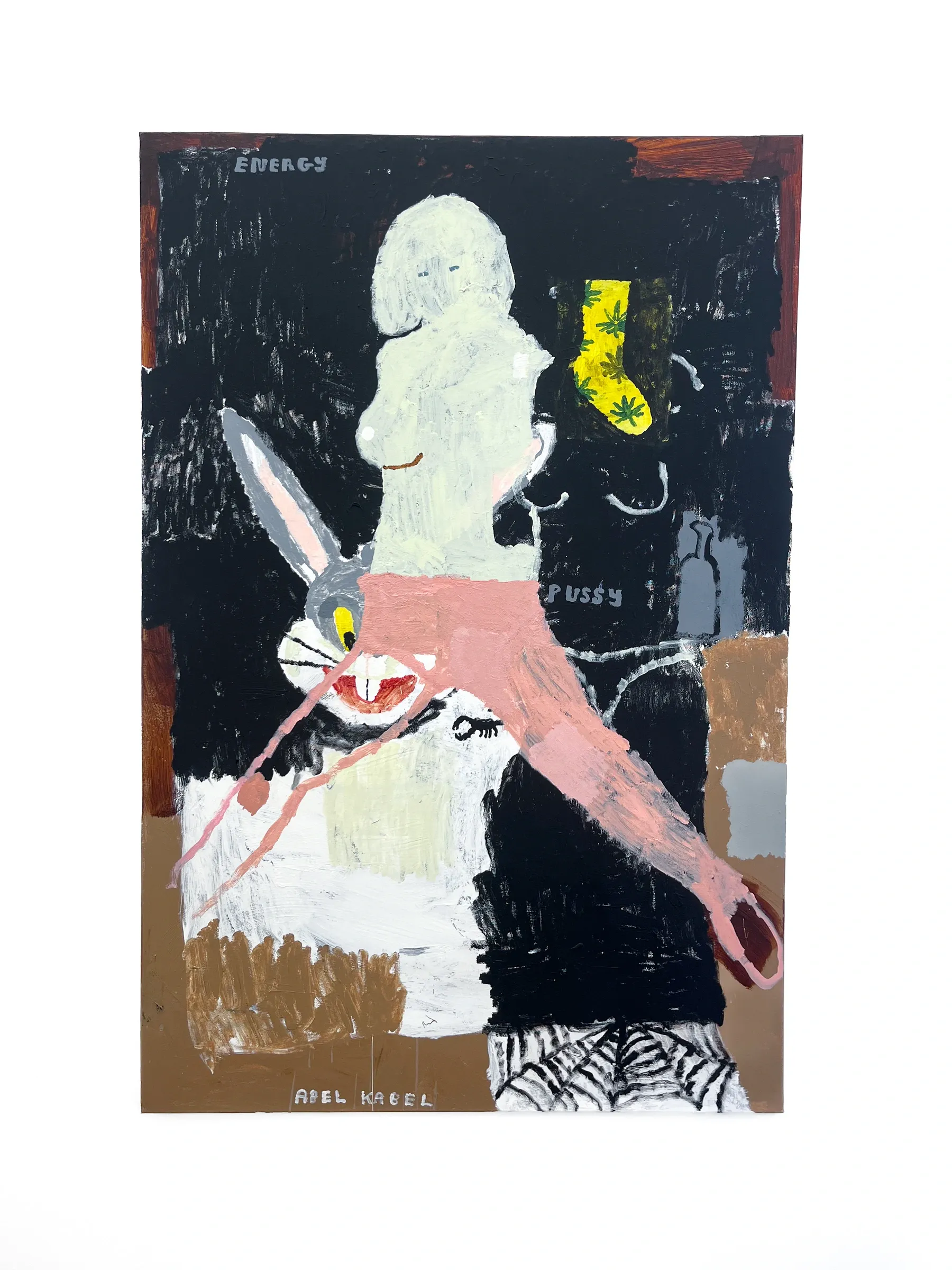
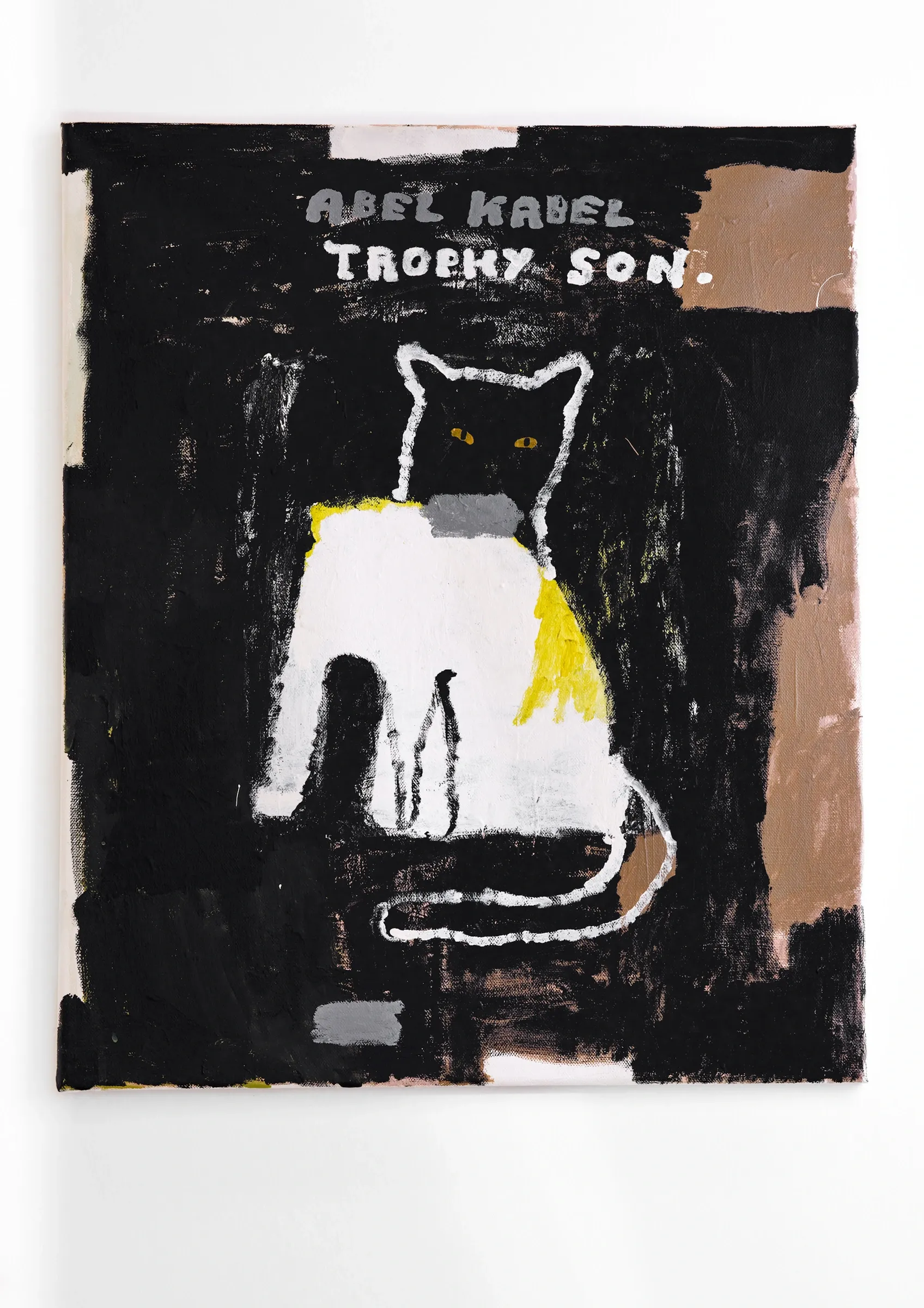
Abel Kabel, Energy Pussy, 2026, 150 x 100 cm, acrylic and wall paint on canvas (right) Trophy Son, 2025, 60 x 50 cm, acrylic and wall paint on canvas.
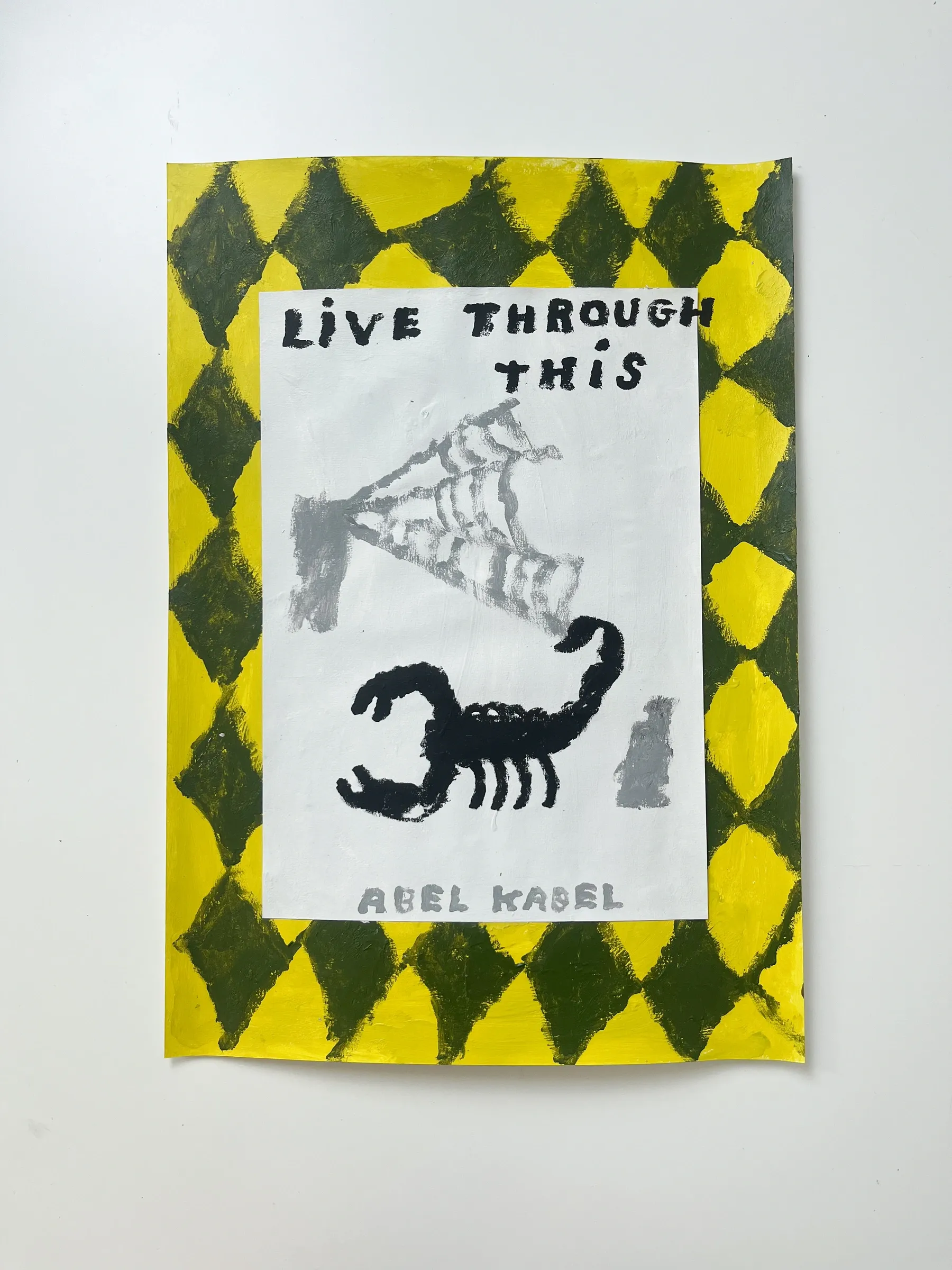
A scorpion keeps returning, and so does a spider web. Neither settles into a symbol. They sit among yellow marks, grey blocks and stray dots the way a sticker sits on a wall, present and slightly beside the point.
The pictures announce themselves like labels, then decline to say what they label.
At Jacob Bjørn Gallery in Aarhus, the solo show Got Guts (10 April to 10 May 2026) put four tall canvases in a row on a single white wall.
Grey and white fields are cut by black, brown and a hard yellow, and one canvas carries the words CEASE 2 EXIST across its black upper edge.
The words are not captions. They are painted at the same pitch as a limb or a leaf.
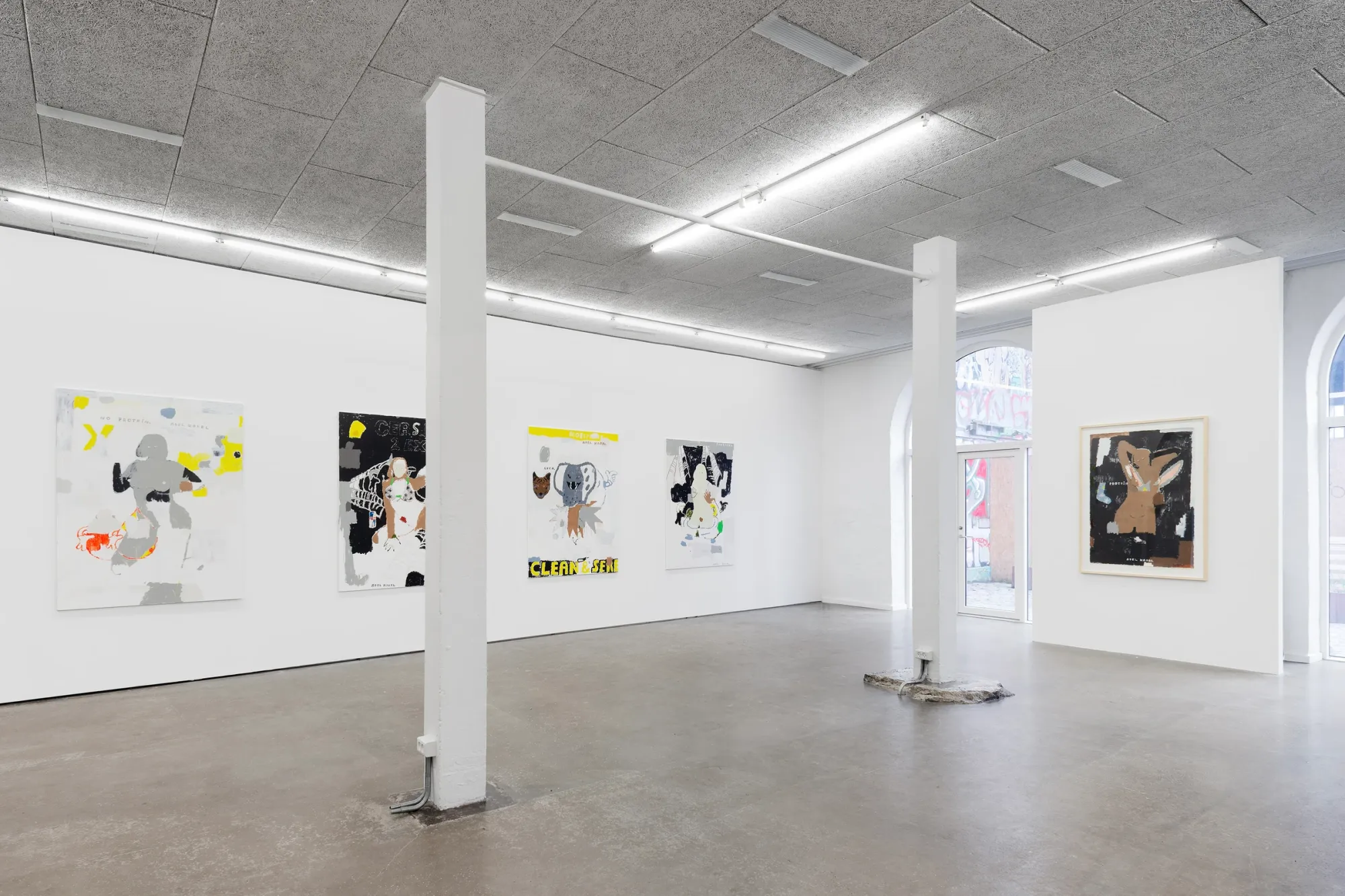
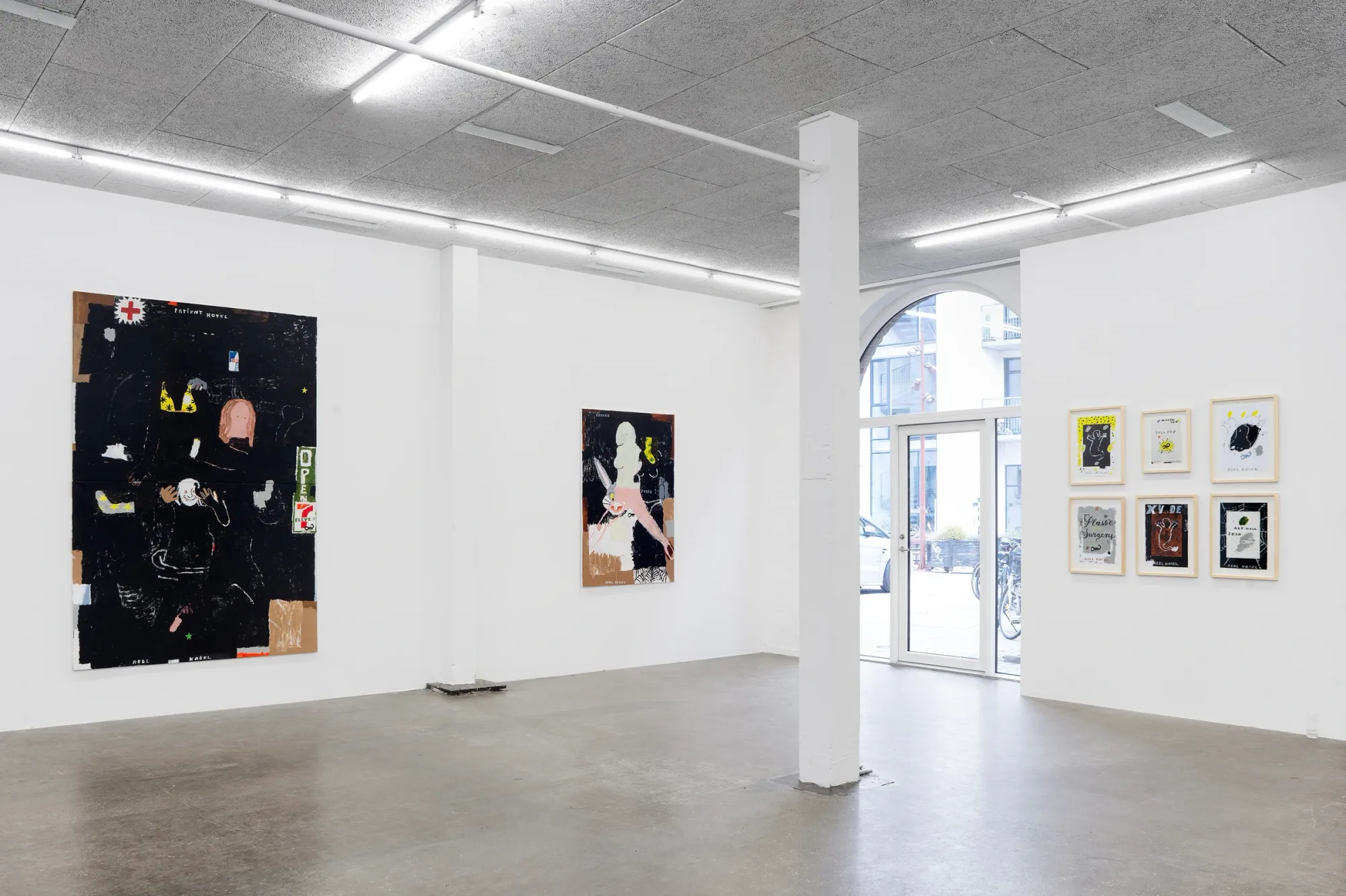
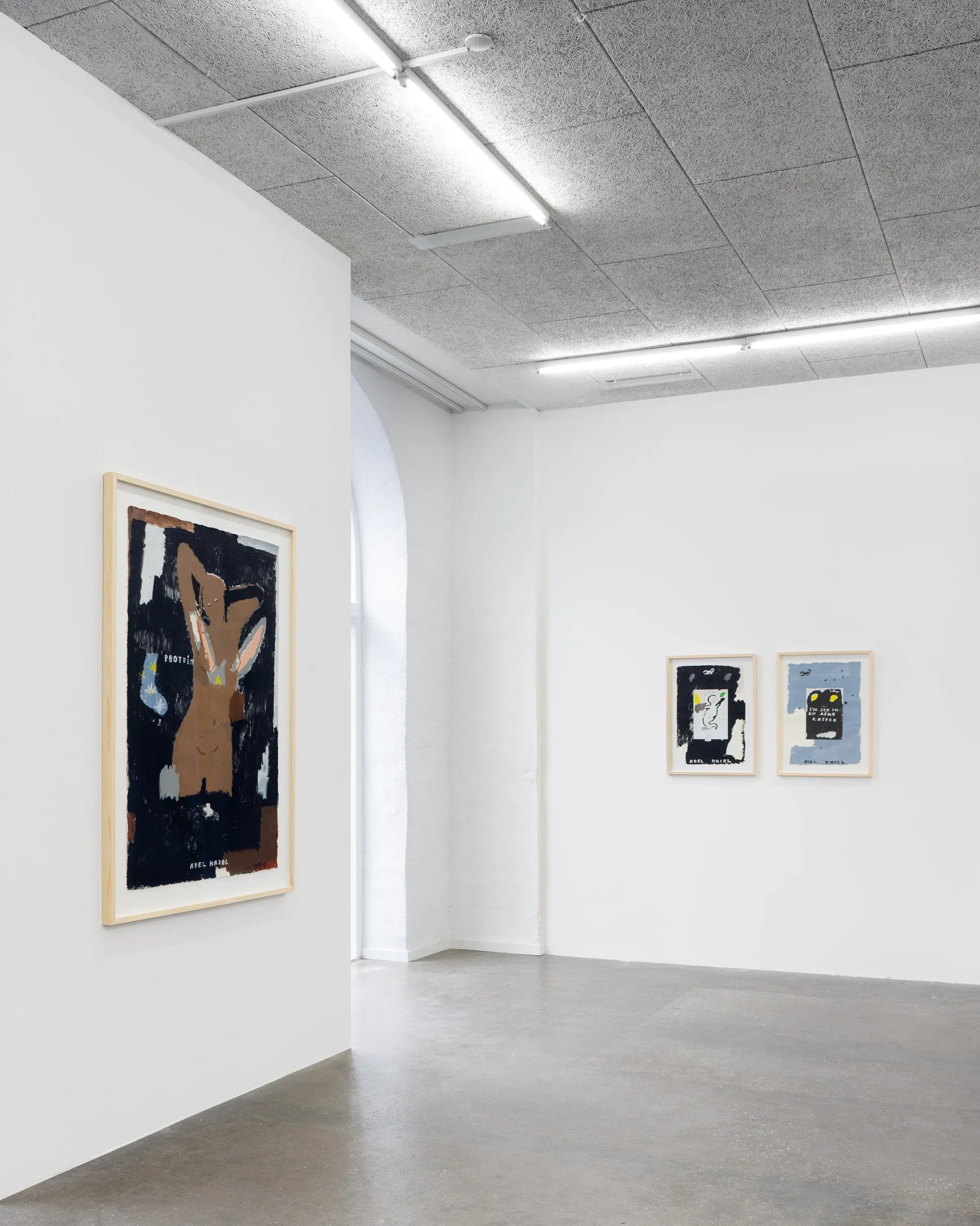
Energy Pussy (2026), in acrylic and wall paint on canvas, shows how the method works. A pale figure rises over a grey rabbit with bared teeth, a pink band cuts diagonally through both, and a yellow sock printed with green leaves hangs in the black.
Nothing is explained, and nothing seems hidden either. Trophy Son (2025) is quieter: a white animal with a black head, outlined like chalk, sits in a black field under the title and the artist's name. It looks like a cat and reads as a label at the same time, and the painting seems content with both.
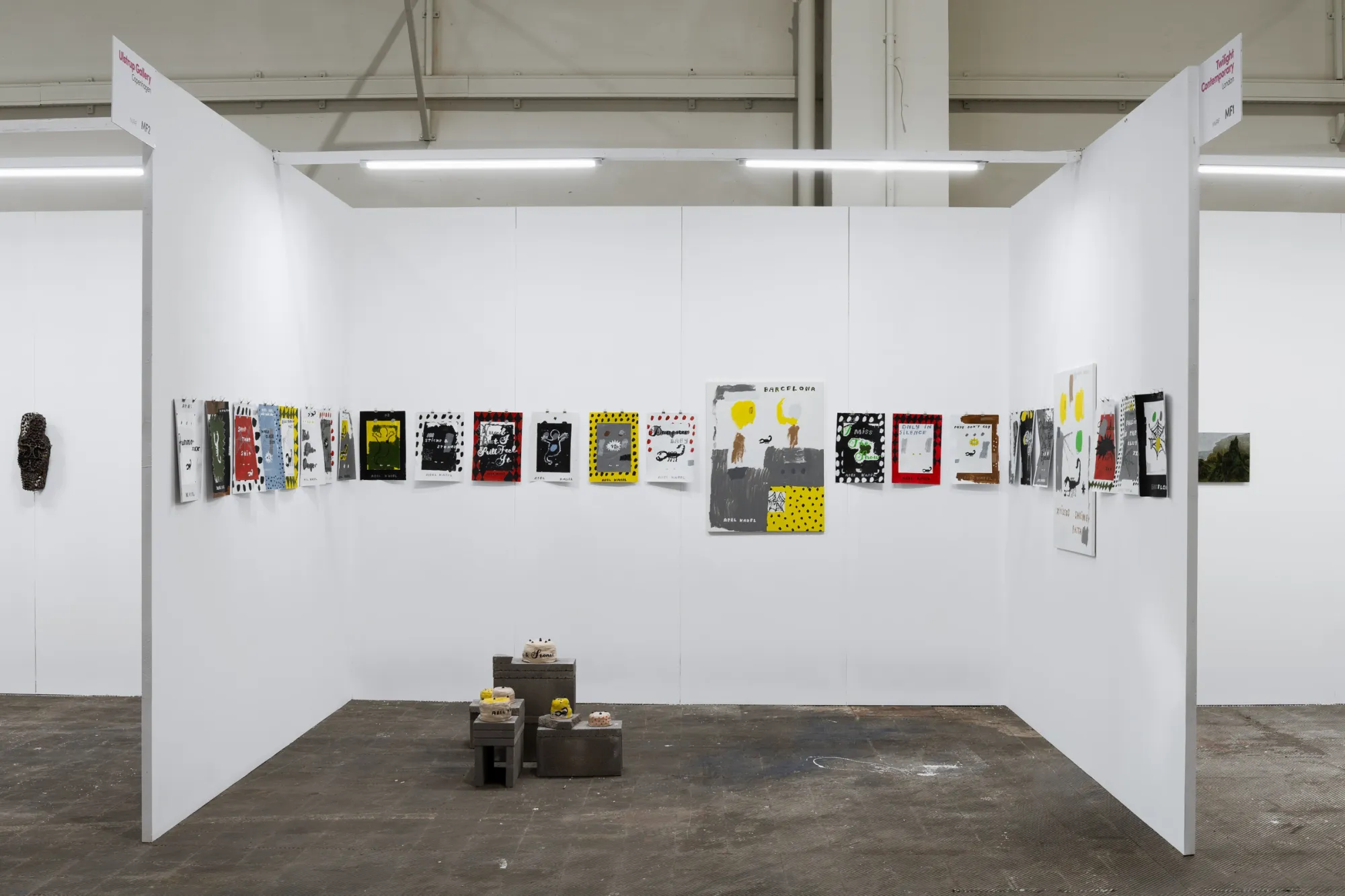
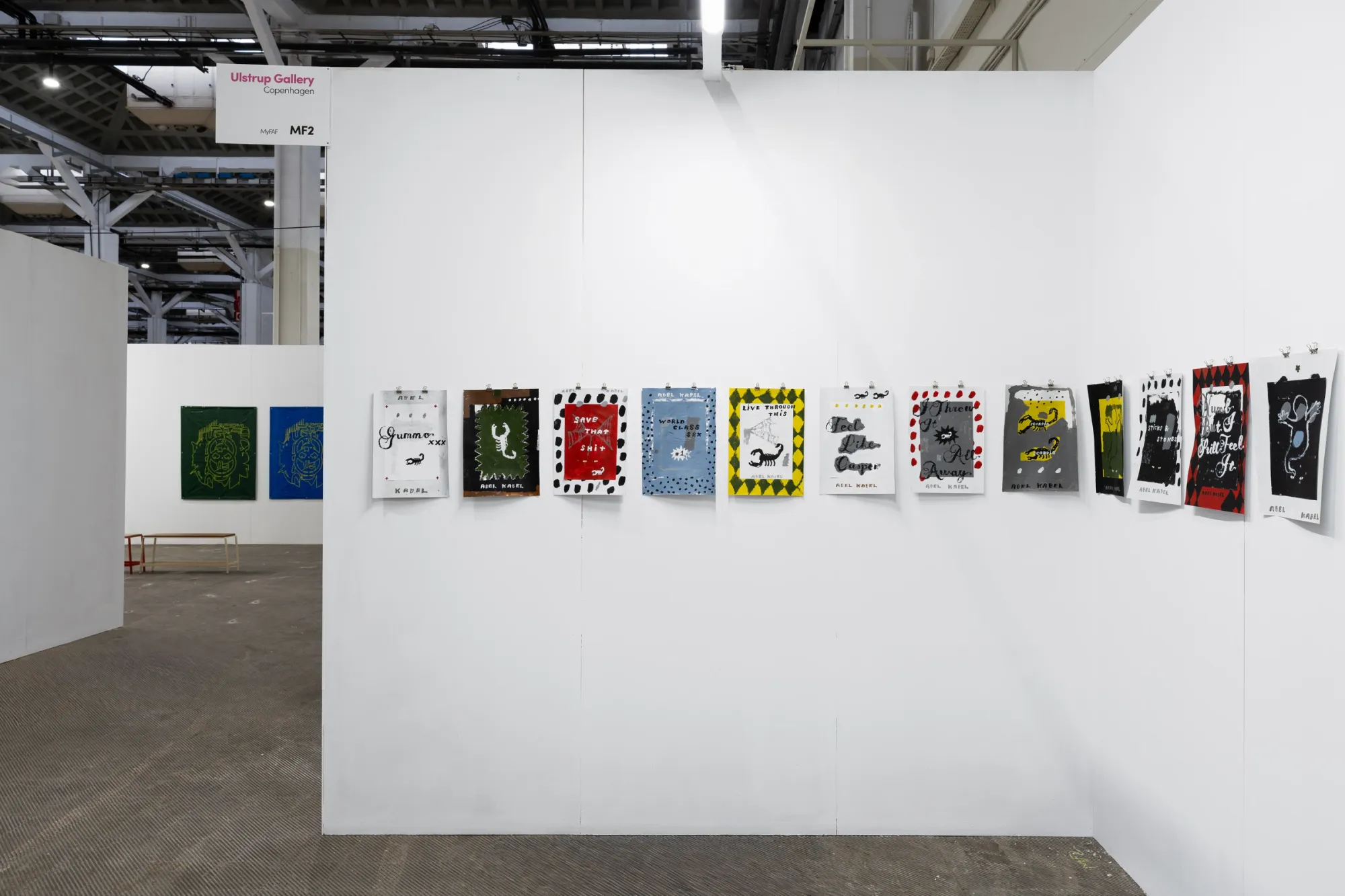
In October 2026 the same logic moved to paper. At SWAB Barcelona
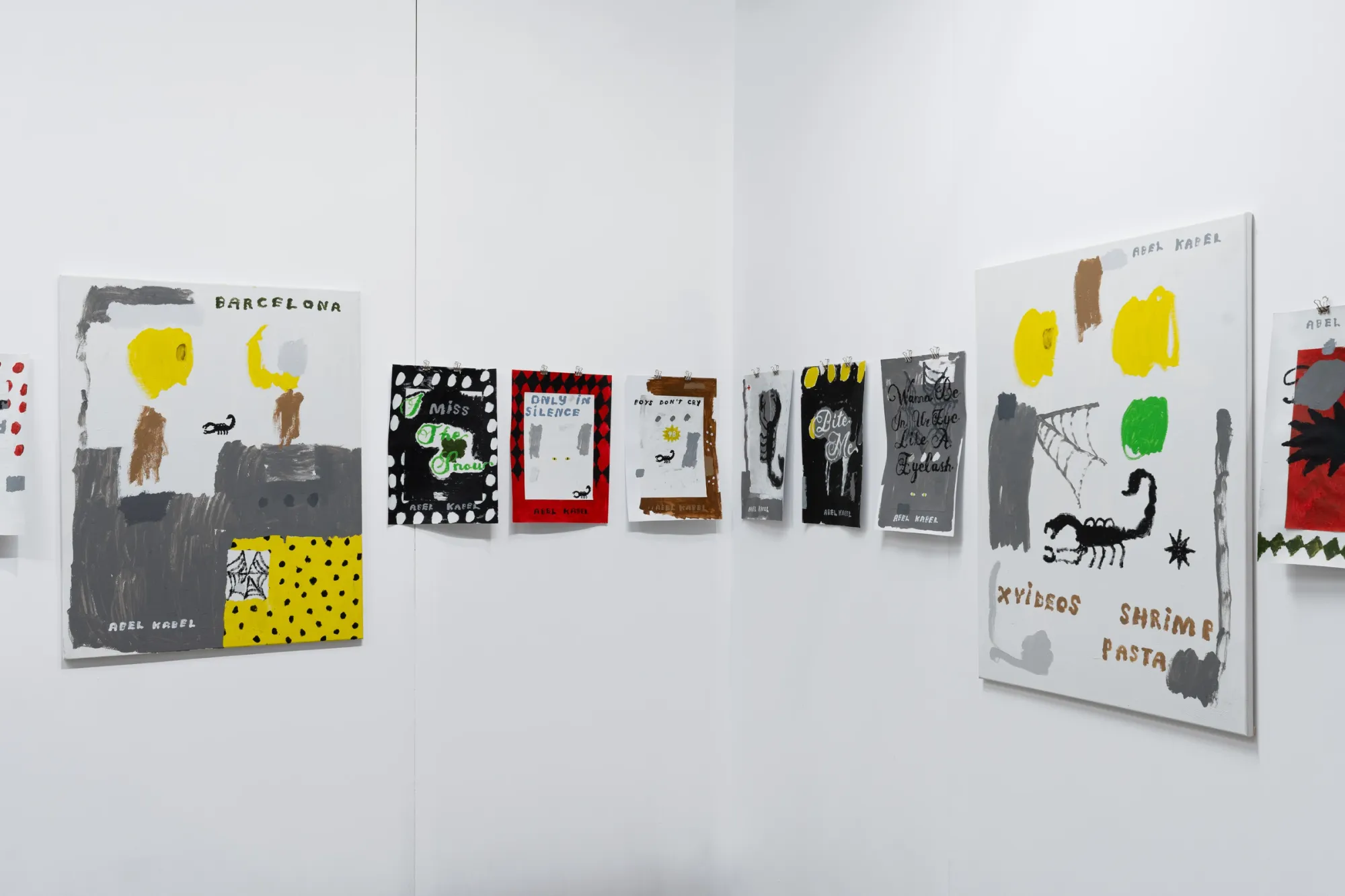
, Ulstrup Gallery presented Kabel in a solo booth in the MyFAF section, with paper works hung in long rows on binder clips.
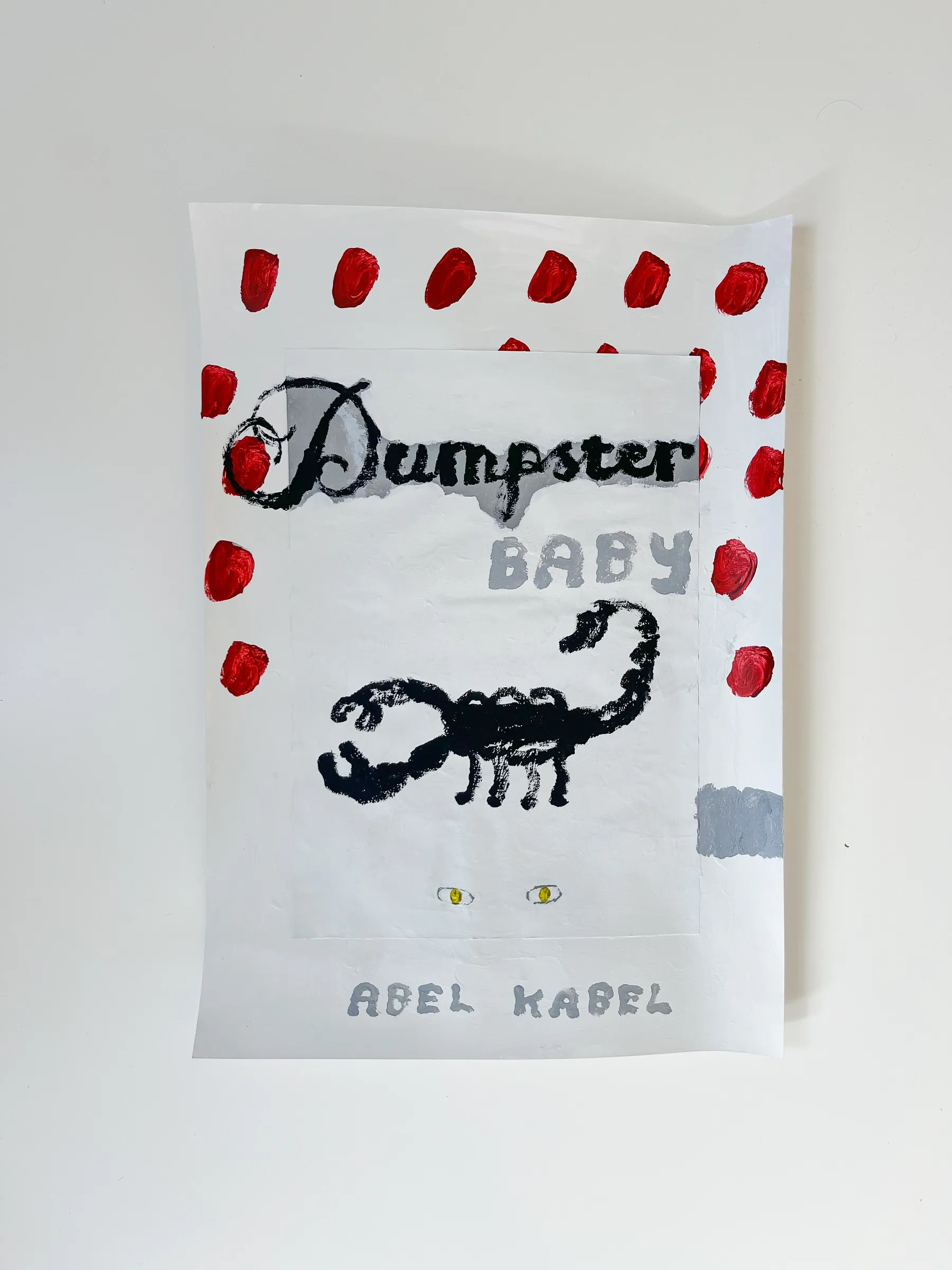
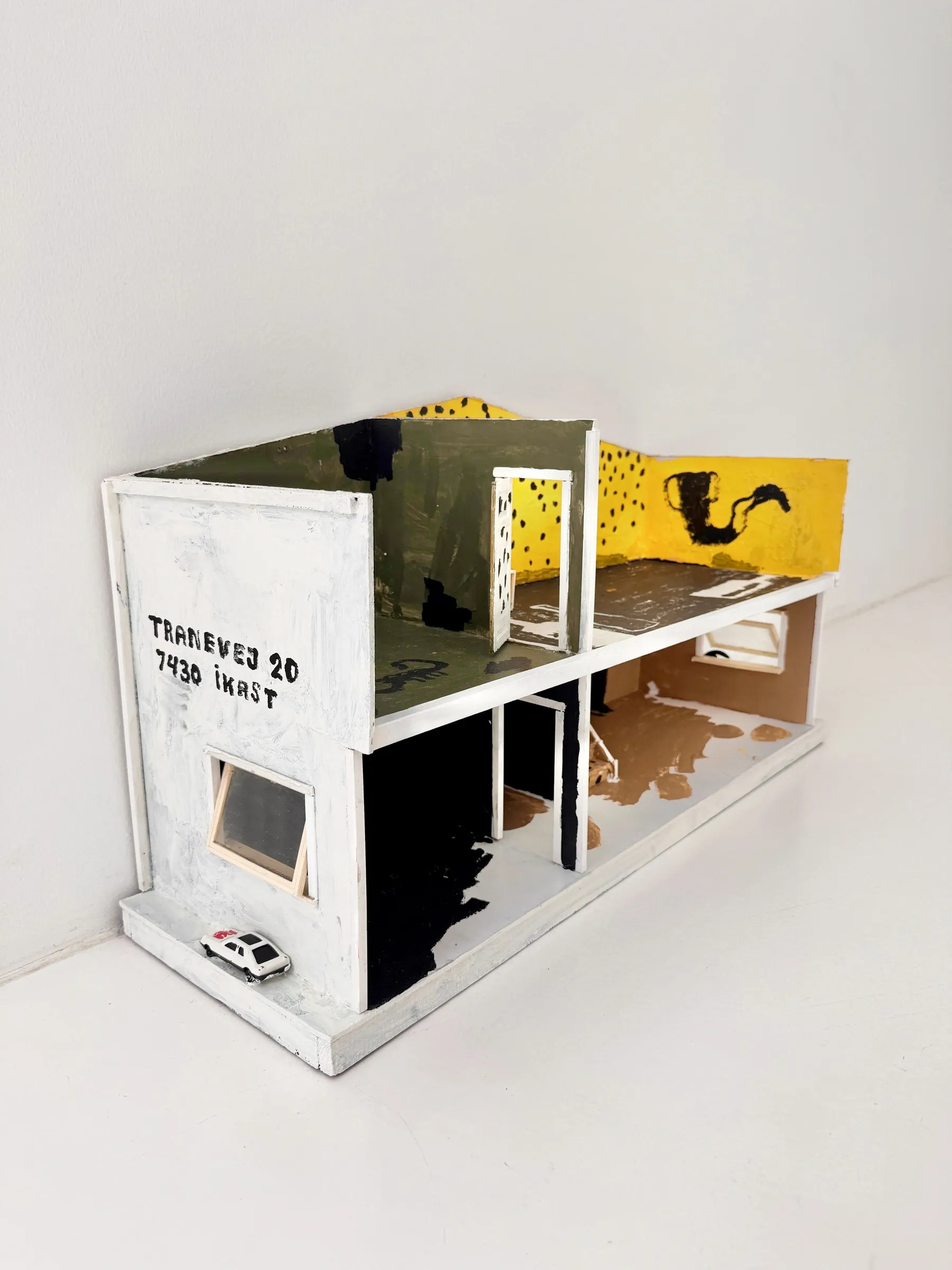
Each is a small white sheet inside a painted border of dots or harlequin diamonds, a scorpion or a web at its centre, under titles such as Live Through This, Dumpster Baby and Save That Shit. The gallery describes the web as both a visual motif and a conceptual space for the presentation. A few small sculptures stood on grey blocks on the floor.
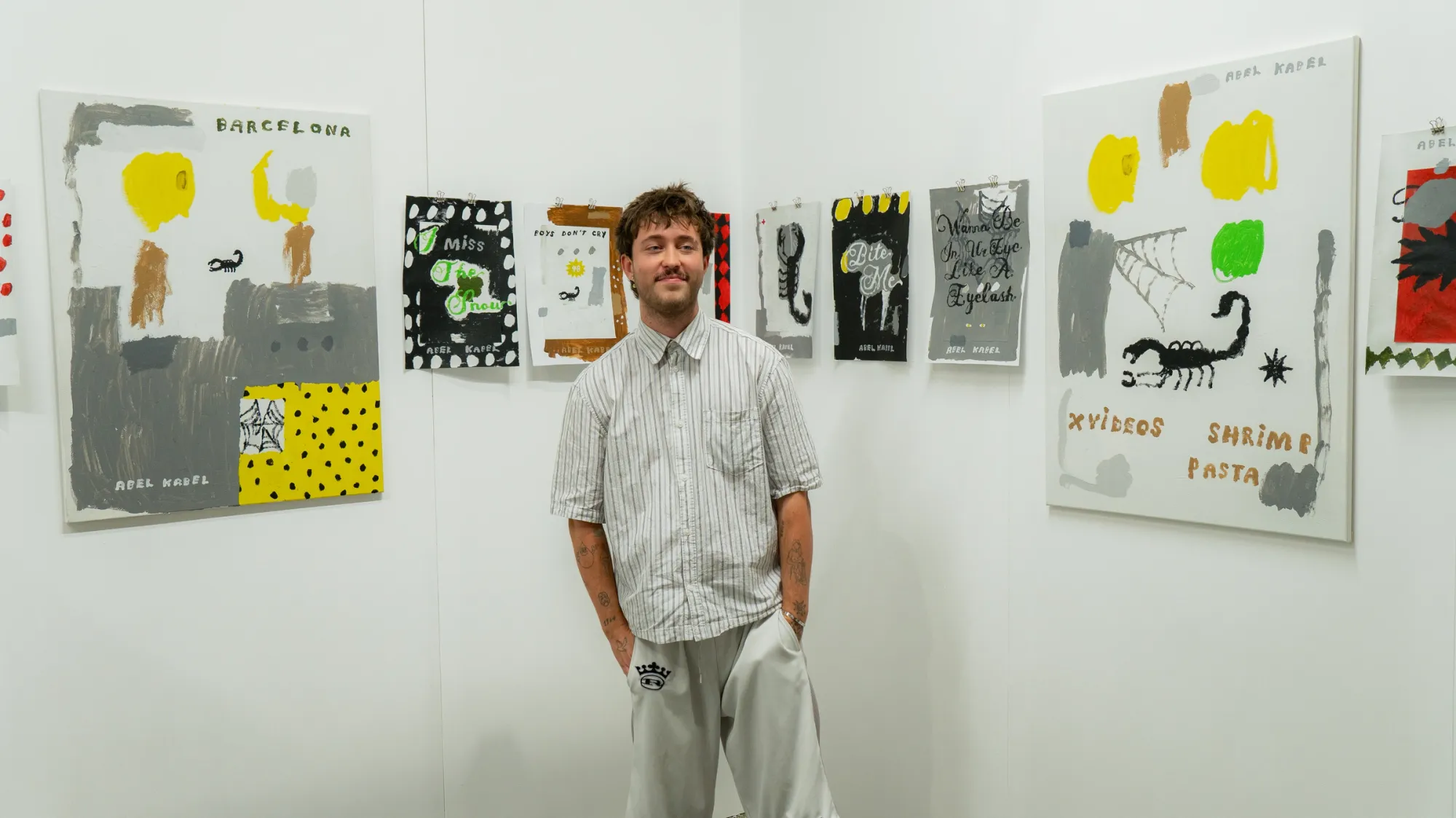
Kabel was born in 2000 in Herning and is self-taught, according to his CV. He works across painting, ceramic sculpture and video, and his short film Turbo Dum has screened at Kunsthal Aarhus in 2023 and at ARoS in 2024.
His statement names identity, queerness and personal struggles as the subject, approached through everyday observation and imagery found online. The label seems to suit that material, since titles, captions and tags are how images online usually get sorted.
What the labels leave out is the thing they were stuck to.
Herning, Denmark, 2000
Aarhus, Denmark
Painting, ceramic sculpture, video
Self-taught
SWAB Barcelona Art Fair (solo presentation), Ulstrup Gallery, 2026
Got Guts, Jacob Bjørn Gallery, Aarhus, 2026
Web Depictions, Ulstrup Gallery, Copenhagen, 2024
abelkabel.com
@abelkabel_
Jacob Friis-Holm Nielsen, Jazmín Nemi
Courtesy the Artist
Earlier Feature, February 2025
The Art of Not Trying: Abel Kabel's Journey Toward Imperfection
Perfection is overrated. At least, that’s what Abel Kabel seems to think, and his work proves it.
Starting his artistic journey as a control freak, Kabel once strove for flawless lines and crisp edges.

But somewhere along the way, he realized something that changed everything: there’s no such thing as perfect art.
And frankly, trying to achieve it is pretty boring. So, Kabel did the unthinkable, he let go.
One of Kabel’s most poignant pieces, Katrine Sorg, delves into his personal experience with Asperger's Syndrome
His transformation from precision to playfulness is at the core of his evolution as an artist.
Kabel’s pieces are like a well-orchestrated mess.
His canvas often looks like a graffiti artist met a fine painter in a dark alley, bold line drawings scrawled over thick, textured layers of paint.

The result? A visceral, imperfect beauty that speaks louder than perfection ever could.
Stickers, Graffiti, and Everything in Between
What sets Kabel apart from the crowd is his unapologetic approach to inspiration. He draws from the unlikeliest of places, like stickers.
Yes, you read that right.
For Kabel, a sticker slapped onto a street sign can be the driving force behind an entire painting.
Graffiti, logos, and pop culture are his muses, and his canvas the playground.

In fact, Kabel’s obsession with the mundane has led to an artistic style that feels both intimate and universal.
His work draws you in with its everyday relatability, and once you're hooked, you find yourself navigating through layers of raw emotion, memory, and energetic spontaneity.

His paintings don’t just speak to you; they yell, laugh, and sometimes cry right in your face.
The Beautiful Chaos of Crude Art
Kabel’s rejection of perfectionism isn’t just a stylistic choice, it’s philosophical.
When asked about his work, he often describes it as "crummy" or "crude." But here’s the thing: he likes it that way.

For Kabel, it’s not about making a polished final product; it’s about the process, the experimentation, the fun of it all.
His paintings are alive with energy because they’re not burdened by the weight of traditional expectations. Truly love that.
 Dominique Catherina Foertig

Abel Kabel News - Exhibition Review
One of Kabel’s most poignant pieces, Katrine Sorg, delves into his personal experience with Asperger's Syndrome.
Using text and abstract visuals, the work portrays both grief and discovery.
The chaotic, rough lines reflect the overwhelming emotions that come with self-understanding.
It’s a powerful reminder that art is a way of processing, and sometimes, it’s the imperfect strokes that best capture life’s complex emotions.

Letting Go of Control: Kabel’s Secret Sauce
So, what’s Kabel’s secret sauce? It's his ability to let go. By relinquishing control, Kabel has discovered a freedom that many artists spend their entire careers searching for.
In his words, "I like making crummy paintings, I still find them beautiful, and I try my best to maintain a balance between perfection and crudeness."
This attitude has allowed him to create pieces that feel immediate and alive.
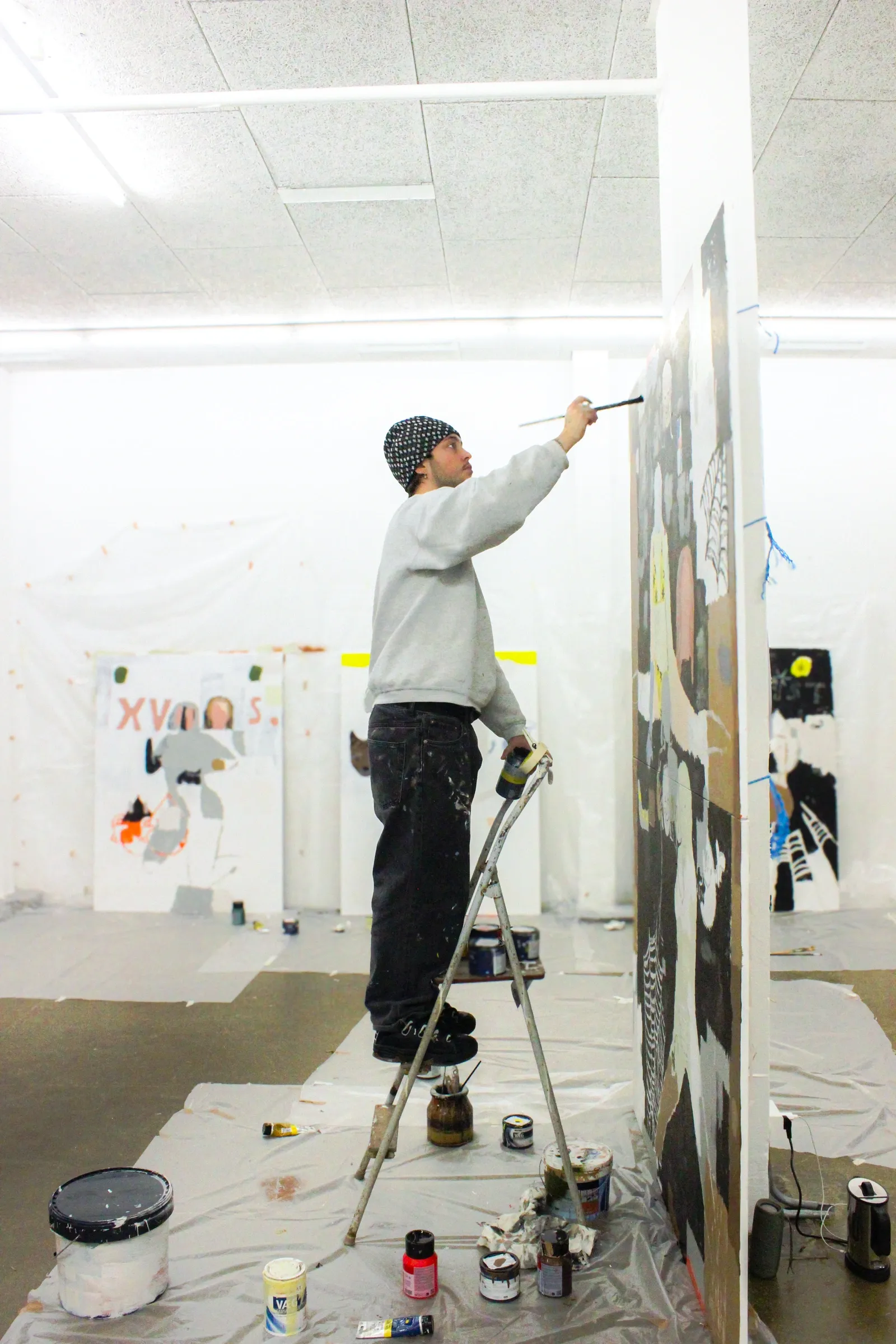
Kabel works in small steps, figuring out the direction as he goes, driven by his hyper-focus, an element of his autism that he says fuels his productivity.

The result is art that feels like a conversation between the artist and the viewer, with Kabel giving you just enough to hold onto while letting your mind wander through the chaos.
Why Abel Kabel Matters
Abel Kabel’s work is more than just visually striking, it’s a commentary on the futility of trying to control everything, in art or in life.


His paintings remind us that beauty lies in the rough edges, the unplanned detours, and the chaotic moments that make life, and art, worthwhile.
For those who need art to be perfect, Kabel’s work is a slap in the face (in the best way possible).
For the rest of us, it’s a breath of fresh air. Abel Kabel is not only an artist to watch, he’s an artist to experience.
This is Abel Kabel´s Instagram , follow for more insights!
About Catapult Contemporary
This is an Artist in Focus feature published by Catapult Contemporary, an independent editorial platform for contemporary art, based in Vienna. We publish exhibition reviews, artist features, interviews, and critical context, with a focus on emerging and mid-career practices from Europe and beyond.
catapult-platform.art ·
Instagram
Want to be featured? Submit your work →
New Readings on Catapult:
No spam, no sharing to third party. Only you and me.